Wednesday, April 30, 2008

And the Summer is Off..with a Squish


Well, it's my first full day of summer break and I find out that due to some paperwork confusion on my part, my student loan to get me through the summer has not come to fruition, will not come to fruition, which leaves your faithful blogger with damned little to get him through the summer, meaning that he'll either have to dip into the mutual fund for another grand tax hit, or get a menial part time job, which will take out a chunk of his last summer of available time to work on his thesis before the school year starts up again.

With that lovely bombshell dropped this morning, I thought it best to get out in the yard to get something productive done, and set to work on digging the stump of the firebush out of the yard.

It turns out there is a rootball on that thing tight enough to make my spade pretty much useless. I've been digging a moat around the thing and am hoping to get under it, cut the main roots, and roll the whole mess out of the ground, which'll leave me with a good start on a swimming pool next to the driveway.

Groceries are up, gas is, in spite of Bush's "not being aware of" such a possibility a month ago, pushing $4, and the cars and people in the area around my neighborhood keep looking shabbier. I remember hearing voters getting interviewed on the radio four years ago. Several mentioned that they had voted for Bush so that "he would have to clean up his own mess." That sure didn't work. The person you'd love to have a beer with, for those of you who have been in bars recently, have a tendency to leave you with the bill on occasion.

A month ago, I heard a primary voter discussing the merits of the two Democratic candidates state that he was for Barack because Hillary didn't seem very nice, and he was certain that if he sat down across the table and had coffee with her, that he wouldn't like her at all. After the past four years, one would think that the public would have learned that beverage-based conversation is not the basis for choosing the leader of a country.

Capuccino, anyone?

Monday, April 28, 2008

The Bear is Dead


My final paper has just been handed in, which means that it's almost time to bid farewell to the Hallowed Halls of Heavilon for another summer. My Creative Writing undergrads have kinda dropped the ball on the portfolio deadline, however. This leaves me rather displeased, as it's cutting into my Summer Time. Grades Shall Be In Tomorrow.

And then I will go home and play in my garden.

Friday, April 25, 2008

Negative Space


Hey all--Still needing to graqde papers, collect portfolios, finalize grades, and write a 20 page paper, but I thought I'd update.

One of the novels we've read is Jacob's Room by Virginia Woolf, wherein the main character is never really actually present. The novel forms a sort of world with a Jacob-shaped hole in it. It's an interesting concept for a novel and one which appears to work for other art forms as well.

James here in my grad office twigged me onto the Garfield minus Garfield website, which republishes the generally yawn-worthy Garfield comic, only with the animals edited out. The result is a grand improvement on the strip. Click on the link and see if I lie. April 2 was a good day.

Friday, April 18, 2008

It was someone in my house...it was a dangerous freak storm...


...it was, um, an earthquake? I snapped awake before 6 this morning for some reason and listened. shortly after I heard the sound of someone walking across my kitchen floor. As the hairs stood up on the back of my neck I realized that the house was making noises, that there was a stranger noise from outside. A storm? I was still groggy and thinking if the house was making all this noise in a storm I was in trouble. By that point I realized my bed was jiggling like a jello-mold salad. In my not-awake-state it briefly crossed my mind that a storm was raging and that the people who had broken in were shaking my bed. It wasn't until I woke up a bit more that I realized it must've been an earthquake or perhaps a powerful explosion somewhere. Sure enough, on the radio this morning, Indiana got a 5.2 earthquake. I haven't checked the basement, but I don't see any new cracks in the ceiling or other such damage. The chimneys dad and I worked on held nicely.
This marks my second Hoosier earthquake. The first one was a really amazingly unlikely combination back in 1986 when our house got hit by a tornado on the same afternoon as the earthquake. I believe the two events were separated by less than two hours. One nice thing about last night's earthquake is that, for about a half hour, it actually convinced the mockingbirds to shut the hell up--they've been singing all night (listen! I'm a Robin! listen! I'm a Blue Jay! listen! I'm a car alarm!...") and driving me nuts. Well, off to the Great Outdoors and then to my paper-writing.

UPDATE:
11:15 a.m., and my lamp is still wobbling--evidently an aftershock. I was sitting here at the computer when my chair started moving under me, and the bookcase swayed. It lasted perhaps 15 seconds, all told. Evidently the mockingbirds are used to this now, as they started right back up singing as soon as the shaking stopped.

UPDATE of UPDATE:
The 11:15 aftershock was 4.6. The mockingbirds are napping, and I think I might follow their lead. Avoiding D.H. Lawrence in such tectonically-active times is hard work.

Sunday, April 13, 2008

A New List for Those Who Love Them


  1. A rewrite of my Mann/Lawrence paper, as my Prof didn't like the first one
  2. The still - unwritten Berryman/ Schnittke paper
  3. A 9-page paper on my poetic drift this semester
  4. Revisions on my pieces for the semester
  5. Grading 15 final papers
  6. Critiquing 2 short stories
  7. State Taxes, on which I'd been holding out until I got more money in the bank, cause if I owe for Federal, I sure as hell am gonna owe for State
  8. Reading an ass-high stack of LitCrit.
  9. Attempt to be in a good mood in spite of items 1-8
One thing might help with my state of mind and that is Lemon Jelly. The music outfit, not the condiment. Overheard this song on KUOW whilst staying with Pez over Christmas and remembered upon returning to check if they had a video. And they do, in which it appears Alexandr Solzhenitsyn has an acid trip:


Saturday, April 05, 2008

Preliminary Tax Situation--2008


It's interesting --well, not interesting, actually--in the past 12 years never have I earned so little, yet owed so much. Not since I worked in Russia have I earned the AGI I'm currently reporting, yet instead of a refund, I actually owe the Federal Government money. Color me pissed. In addition, I was notified of my "economy stimulus" payout a/k/a The Bribe to All Citizens the Government Cant Afford, and in spite of all I've just mentioned, I don't even qualify for the full $600. I certainly hope those jerks in their Hummers (who would name a car after a blowjob?) enjoy their economic stimulation. I, for one, have already spent it--on rent, gas, and utility payments. Thank god I won that poetry award, which won't even cover my mortgage payment and gradpad rent payment for the month. But I sure as hell have to report it as "income" on my taxes for 2008. Bitter, party of one?

Sunday, March 30, 2008


  1. 15-page paper on D. H. Lawrence and the suppression of desire.
  2. 20-page paper on John Berryman's Dream Songs and a connection with form and tone in the music of Alfred Schnittke
  3. Rereading aforementioned Dream Songs
  4. Taxes
  5. Grading 8 papers
  6. Critiquing 2 short stories for workshop
  7. Critiquing 8 poems for workshop
  8. Writing 2 poems for workshop
  9. Laundry
  10. Week's plan for English 106 and 205
  11. Critiquing 17 poetry portfolios and typing up suggestions
  12. By Wednesday
  13. Oh, and writing a thesis-reading introduction
  14. You get the idea

Friday, March 21, 2008

As of this evening...


The Hardee's sign is still as pictured in my previous post. I'm wondering how many Jalapeno Thickpurges they've managed to sell in the meantime.

I've got much to write about, but nothing well-formed enough to make it sound at all intelligent.

Went to teach class this morning, then went to a local auction where I bought a small end-table for around $50, then came home, bought a small amount of groceries, memorized a poem about oral sex for class on Monday, and read 50 pages of a book. Overall, a day that fits in the "Not at all bad" category. I attempted to eat Mexican while reading Gertrude Stein and, well, it was easier trying to keep the salsa on the chips, quite frankly. I get the fact that Lucy Church is actually a church building and that there are various characters which could be the saints that inhabit said church (the characters are named John Mary, James Mary, and Simon Therese, among others) but then I get to passages like this:

In place of strange.
Complicated horses now. Horses now cow now complicated horses now. Horses now horses and a cow now. Complicated horses now.
It is torn in between and shells egg shells it is best as yellow peaches with a rose rosy rosy green.
Lucy Church an advantage Lucy Church made by it being with them it is attempting with them attempting with them. And might it be that that good good good if if it is not a bee or a wind a bee is from there and the wind is from there and so sheep so sewn so seated so when and then then so so much as much as withdraw.

And at that, I just have to turn to my plate of chips and refrieds and munch on that. I've found a book I need to send someone, I've got 14 papers to grade, as well as a number of other household tasks to do. Complicated horses now. Complicated now. Now. Not a bee or a wind. Complicated horses. Now.

The pic is from Berlin, very near Potsdamerplatz, the strange preserved remnants of a hotel where all the bright set sat. The dining room where Chaplin had breakfast, where Dietrich ordered eggs, now exposed to air, enclosed in glass and avant-garde architecture. The scarf gone, the coat still worn, the cold not the same but back, now there, now waning.

Wednesday, March 12, 2008

There's Truth in Advertising...


After my 75th nap of the week, I went staggering off to the neighborhood grocery store to get a bit of food (yogurt? no--they don't have my brand, haven't had it since yesterday) for the rest of the week (vegetables? Nix--Mondo expensivo and all from Chile), so I don't starve (shark-shaped fruit snacks? Check--and for only a dollar a box. I'll take two, thanks...). And as I near Hardees I see their improvised sign. On closer examination, the P was modified to be a B using sharpie pen, but that alteration all but vanishes once backlit. The wind has carried off the ending R, so what you have is a perfect description of Hardee's latest burger. I wonder how long it'll be before they notice. I ran home to get the camera so that all of my ones of blogreaders can enjoy the moment with me.

I am good for little else than reading and napping still; here's hoping I can scrape it together for the remainder of the week, as I have serious shizz to do. In the interim, I nap and try to make sense out of Gertrude Stein, who makes sense occasionally, then doesn't make sense at all, then comes up with a gem of a line. For example, one paragraph from the opening to Lucy Church Amiably:

This altogether makes a return to romantic nature that is it makes a landscape look like an engraving in which there are some people, after all if they are to be seen there they feel as pretty as they look and this makes it have a river a gorge an inundation and a remarkable meadowed mass which is whatever they use not to feed but to bed cows.

and a page later:

No history of a family to close with those and close. Never shall he be alone to be alone to be alone to be alone to them to lend a hand and leave it left and wasted.

But more of Stein at a later date.

Tuesday, March 11, 2008

Virulent Mayhem and Administrative Ignorance


Well, this morning was certainly a new low in the illness department. I was reduced to rolling around on the bed for hours, squeezing my skull in the hopes it wouldn't come apart due to sinus pressure. Any worse and for any longer and I was going to stumble to the car and hit the hospital. Things have lightened up significantly since then, but I've been up all of 5 hours so far today. And going to the drugstore across the street was a lovely experience, what with having to show all that I.D. just to get Sudafed, then having to use the stylus thingie to sign an electronic screen certifying that I'm gonna use the Sudafed for congestion control and not to concoct anything in my basement that'll keep me up the three days. When I'm sick, I'm super-anal about being an agent of contagion and had brought my own pen so as to sign the credit card receipt, but no, I had to grab the germy stylus and add my own pathogens to it for any other subsequent signers to catch.

After waking up from nap No. 3, I grabbed my cloth bags and headed to Kroger for some food, as I'm fresh out. As I was walking under the gas station canopy toward the grocery store, I noticed the current price of gas. Now, it was only a week ago that Bush, at his press conference, said in that can-it-with-questions-like-that tone that he "hadn't heard" of projections that gas was going to top $4 a gallon. It's been a week since and I see that regular here is at $3.49 and diesel is at $3.80. He's from an oil family, his family is a big player in the global Oil game, and he comes up with something like that? "Interesting..." he says, "hadn't heard that..." It's certainly gonna be a long time until January if this is how he's gonna be for the rest of his administration.

Monday, March 10, 2008

Two Dreams--


Same night:
In a large gymnasium. There are other folk around for some event or other. As people talk below of the persecution of people in Middle Eastern countries, I find myself way high up, tightrope-style on a metal electrical conduit. I am close enough to the cement slab ceiling that I am steadying myself on another conduit that runs along the ceiling, pinching it between my thumb and the side of my forefinger. People talking intently far below me. I manage to get to the wall and, with the same pinchlike hold, slide down a conduit to the gym floor. I keep mentally reminding myself that I'm traveling soon and need to make arrangements. When am I going? Around the 15th? Have I put off making arrangements for too long? Not quite, but I need to make arrangements soon, right after this engagement, which people are slowly gathering for, whatever it is. The whole gym is brilliantly lit rosy orange-pink from the high-pressure sodium bulbs along the ceiling.

---

It's warm and I'm in bed. I wake up perhaps an hour or so before sunrise, perhaps more. I roll over and look out my two bedroom windows--which have been open--to the neighboring house. The neighbor, who has been gone for a while (or have I been hearing her in my sleep and therefore has she just left?) has left some lights on: through her window I see mundanely-framed objects; a lightswitch, half an arched doorway to the hall, half a pictureframe. Something motivates me to go outside and inspect--is there someone out there that shouldn't be? I'm still thinking about the need to make travel arrangements. I walk along the north side of the house. The neighbor's house looks recently-vacated--the light inside still on, the silence seeming somehow fresh, somehow recently-instated. The neighbor's car (an Escort, European-style, with extra-large headlights) sits in the parking lot behind the house. In fact, the parking lot extends all the way to Euclid street for several lots where houses used to be. How long have the houses been gone now? The lot all well-lit by high-pressure sodium vapor security lights. I hear barking behind me. Rounding the corner of the house by the front porch is Samson, our dog back in the '80s. He thinks I'm an intruder. I call him Winton (the neighbor's dog's name, whose house I just discovered no longer exists). I correct myself and call him by his right name but he's already recognized my voice. Before the dog's bark, before I turned around, I could see the stars above, all clearly visible in spite of the lighting, in that way that a pre-dawn winter sky is bright and icily clear. Leo had wheeled around and was about to head under the horizon to the northwest. And the song playing as soundtrack to both dreams? An ever-repeating opening half of "Deja-Vu" by Dionne Warwick.

Im so very...


...happy to have gotten a cold on my first official day of Spring Break. I just can't tell you how happy. Well, I could, but I'm sticking to the positive.

I've paid my mortgage, am thusly poor, and have the rest of the day to try to read and do things when I'd really like to scoop the insides of my skull out with a spoon.

Saturday, March 08, 2008

Everything is So Dangerous That Nothing is Really Frightening


...so saith Gertrude Stein. And it's true. Looking back, most of our recollections of childhood and adolescence will have us wondering how we ever survived this long. I'm comfortably into double-digits as far as near scrapes that come to mind. And those are only the ones that one evaded back when we were young and stupid and didn't know what else was going on in this great wide world. One result of this is to react the way Stein does in her quote, or another is to work on insulating oneself from possible harm, and to keep an eye out for nascent threats. Based on my rather non-scientific observations, the latter reaction tends to result in spending most of one's time looking out for the start of a bad trend, for ulterior motives, for things that might point in a dark direction, any of which could result in having to take decisive or evasive action. After a while, such a focus tends to make one more than a bit on the cagey side. One looks ahead, as in chess, two moves, four moves ahead, and with each jump further ahead in time, the possible moves that act as threat are squared, then cubed. After a while, you're jumpy as a caffeinated hare and just as frozen as all these perceived threats close in.
Lots of such people exist. I'm sure you know the sort--they find gated communities attractive, drive as big an SUV as possible because they're safe (though they put drivers of smaller cars at greater risk of injury), they go to jobs they don't like because the money isn't bad and the benefits are good, they spend most of their time cultivating the company of people they don't like and who don't like them, generally out of an idea that such networking will be beneficial regarding one's social standing.
If there's one thing I've been unlearning, it's just such a habit of fearful squinting so many moves ahead. It's a habit I've gained over the past 15 years; of doing silly things like trying to get on in offices and trying to play things their way. While I was doing so, I found myself walking more and more into the middle of things that I actually was wanting to get away from. Rather than gaining independence, I was more and more tied to the opinions and whims of people that didn't know what language people spoke in Scotland or that the main job of our President is to uphold the Constitution, not do whatever it takes to make it more comfortable for us to get cheaply-made knickknacks made in Indonesia just like those ones they used in Trading Spaces. And at 38, I'm too old to have people like that always around thinking up new ways to make my life uncomfortable. I've got crap to do.
Speaking of Stein, while at the bookstore today (I'd gone out simply to take some Auden back to the library and suddenly I'm at Half Price) I found two rare Stein novels, evidently republished not long ago by Dalkey Archive: the never-anthologized Lucy Church Amiably and the behemoth and not-published-since-1934 (and then only in abridged form) The Making of Americans--all 925 pages of it. In her inimitable way, she writes in a letter to Carl VanVechten, that
Lots of people will thinkmany strange things in it as to tenses and persons and adjectives and adverbs and divisions are due to the french compositors' errors but they are not it is quite as I worked at it and even when I tried to change it well I didn't really try but I went over it to see if it could go different and I always found myself forced back into its incorrectnesses so there they stand. There are some pretty wonderful sentences in it and we know how fond we both are of sentences.

This passage alone is a good example of Stein's hatred of the comma.

Much reading tomorrow, methinks.

Friday, March 07, 2008

Not that You'd Know it Here...


...but it's Spring Break. 4 inches of snow so far, though it should still be falling for the next seven hours yet. My ThingsToDo list is outta control. But hey, I've got some groceries, my bread machine, 1800 books, and a can of cashews. I may actually be most of the way through my reading list by the time the rescue crews manage to come down the chimney.

Actual mental activity might return by tomorrow. Until then, I'm off to bed. If I never see an Elizabeth Bishop poem in the meantime, I certainly won't mind.
The picture above isn't of my neighborhood, but that of one of my poetry profs in West Lafayette. My car was parked between the two pickups. For some reason I got a ticket, with a given reason that I was in a 2-hour spot. Please note that there is no sign anywhere near the parking spot indicating that. I contested the ticket, and the ticket lady--no doubt an embittered soul (whose only feeling of power rests in jabbing orange envelopes into people's windows so that they freeze and cannot be removed without tearing, leaving half of the envelope stuck underneath the weatherstrip to fall into the window mechanism--not that I'm at all bitter about that), informed me that she would not waive the ticket, in spite of photographic evidence that there was no sign. This leaves me only one further option, which is to go to court to fight it. If I can get ticketed here, where can't I get ticketed? Also, please note that the two trucks--which were there at the same time, got snowed on, and were there the following morning when I took the pic don't have tickets. Grr.

Sunday, March 02, 2008

Wrestling the Bear


Hey all--I'll post more sometime after I get these zillions of things done. Even though I teach how to write term papers, such writing doesn't come particularly easily to me, and have two papers due this week which I want to have done by Tuesday. I have some other research I need to work on for my year after graduation. The Sycamore Review bash was lovely, as was the party afterwards, though they did little to forward progress on aforementioned papers.

Later, taters...

Sunday, February 24, 2008

Food for thought

I'll likely get flak for posting this, but I found this interesting and haven't got much time to type up posts, what with reading and writing and all...

Tuesday, February 19, 2008

The Supreme Court Has ( n o t ) Spoken...

...and in honor of their inaction, I include the following video by Fiore for your enjoyment.


Don't you feel safer already? I sure do... yeah.

Sunday, February 17, 2008

The Art of Losing's Not Hard to Master...

Been reading Elizabeth Bishop's big villanelle lately, as have most of those reading this blog, when I saw this video, and hell, it's ...thought so. Here's Sia, who in web searches, is often confused with Singapore International Airlines, with her song Buttons:


And speaking of the art of losing, she's the one who wrote the song that accompanied the best ending episode to any series I've seen, Six Feet Under:


Saturday, February 16, 2008

All Work and No Play?


I was so wiped out after driving back home from college that, after I got some groceries (a bit of lunch meat, yogurt, some chicken) I fell asleep before I even put it in the refrigerator. And I slept for over 12 hours. So much for the perishables. Since morning, I've read a D. H. Lawrence novella and half of a 75-page essay on scansion, done 3 loads of laundry (two more to go), and betrayed my resolution to eat healthy food by going to a nearby Mexican restaurant. While reading the rest of the essay (and possibly also while grading 20 term papers), I'll be listening to Silvestrov's Symphony No. 6, hopefully enough to have an idea of what to write for a review.

Yet to do this weekend--
grading of aforementioned papers
writing of two poetic masterpieces
writing of aforementioned review

This coming week I'll be reading the entire output of either Anne Sexton or Elizabeth Bishop for a paper due in two weeks, reading a decade's worth of the Georgia Review for another paper due in several weeks, and deciding what passage to write a 5-page essay on for my Modernist British Fiction class--for this last one, I'm wondering if I should go for the Lawrence, as my dislike of The Virgin and the Gipsy may make it an easier paper to write. I'd heard from some established author or other (who was it--Gary Snyder, Ellen Bryant Voigt?) that, though Lawrence wrote a great deal, he essentially wrote the same novel eight times over. I don't know if that's true, but The Virgin and the Gipsy is pretty damned sloppy writing. One of the characters, who is named, who comes in toward the end of the work is referred to as "the little Jewess" something on the order of five times per page. Not "she" or by her name: "the little Jewess." Occasionally, he will refer to her as "the tiny Jewess" for infrequent variety (who is this--Yentl-belle?), but that's about it. It would be fun to tear this book apart, but in all likelihood, I'll take the high road and go for something by Elizabeth Bowen or perhaps Dorothy Richardson.

The scansion essay calls.

Saturday, February 09, 2008

The immense stylizations o' Bananarama

In 80s form, I thought I'd put up some stuff where Bananarama--the trio so talented they only sang in unison--actually was cool.

For example, their collaborations with Fun Boy Three--


Their big hit had me interested in them at the time--


but they had little else to do but make dancier versions of 60s and 70s tunes, all again sung almost entirely in unison unless the chorus tricked them into doing otherwise...


Siobhan, the brunette, managed to redeem herself by marrying David Stewart of Eurythmics and forming Shakespear's Sister. They first came on the scene with a song called Heroine which has Siobhan running around in a wedding dress. The song , though it has its moments, is pretty much typical late 80s pop. Later, though, Shakespear's Sister had a song with one of the best videos of the early Nineties, directed by the wonderful Sophie Muller:


The video spoke heavily on certain levels to AIDS, the many deaths simply swept under the rug, Siobhan's appearance at the time was electrifying, there as Death-as-seductress, confident of winning. After this, they essentially dropped off the planet. Sophie Muller continued on, directing great videos for Eurythmics and Blur, among others.

Asleep in the Dark of You, It Feels Like I Never Saw Sun--Another Rabbit Hole

I heard that Kylie Minogue has a new CD out, so I checked out her latest single. Based on the imagery in the first single's video, with its bedazzled skulls and Kylie all made up like Anna Nicole, this seems a bit darker of an album than her fans are used to, perhaps drawing from her recent cancer battle.

It also sounds a good deal smarter than her previous efforts. Her breakthrough hit of a few years back "Cant Get You out of My Head" was destined to be a big hit, but half the song being nothing but "Na-na-na" obviated the video of her wearing a gas station towel belt and two staples. I noticed the song title of her new single is the same as an 80s song by Stacy Q, the woman who brought hair crimping to the masses--millions of hapless teens baked their locks into brittle lasagna noodles for a full year before having to cut it all off. The Kylie song's melody is based heavily on the Stacy Q chorus motif of "I need you I need you."
I remember hearing the Stacy Q song on the bus radio on the way to high school in those dreary midwinter mornings just as we were having to pick up those hellish trailer court kids. The Stacy Q song is in turn a big rip-off of Madonna's own "Dress You Up"
--the "I need you I need you" is "all over all over" in the Madonna song, as evidenced by the videos supplied herein...

Blessed Be the Poor in Spirit


Hi all, just got this disc last week for review, and think it's kinda nifty For fans of ambient music--Eno, Feldman to some extent, and Aphex Twin's quieter moments--this might be worth looking into. A review will be showing up in the next week or so on Musicweb-International, the link to which is on the right side of the screen.

Lang makes the interesting argument that church masses shouldn't be there to fill the minds of parishioners with pictures, stories, etc, but--and I'm paraphrasing here-- are instead to empty the mind of earthly things, ostensibly so that it can be filled with things unearthly. The music for this mass works toward that end. The ambient-loving Davo likes this for the fact it is another ambient work I can listen to (it's just about the same length as Brian Eno's Neroli), the crotchety Davo is wondering why we have an hour-long extension of David Bowie's not-often heard ambient track Ian Fish, U.K. Heir off his overlooked TV soundtrack to the British TV show The Buddha of Suburbia. These two pieces are strikingly similar. No doubt you can hear snippets of the Bowie song on Itunes or elsewhere. If you like that, look this up.

Friday, February 08, 2008

and forms, and forms...


Sonnet sequences aren't dead. This from page 42
Ellen Bryant Voigt's amazing Kyrie, a sequence on the great flu epidemic--

How we survived: we locked the doors
and let nobody in. Each night we sang.
Ate only bread in a bowl of buttermilk.
Boiled the drinking water from the well,
clipped our hair to the scalp, slept in steam.
Rubbed our chests with camphor, backs
with mustard, legs and thighs with fatback
and buried the rind. Since we had no lambs
I cut the cat's throat, Xed the door
and put the carcass out to draw the flies.
I raised an upstairs window and watched them go--
swollen, shiny black, green-backed, green-eyed--
fleeing the house, taking the sickness with them.

And this from page 55:

Who said the worst was past, who knew
such a thing? Someone writing history,
someone looking down on us
from the clouds. Down here, snow and wind:
cold blew through the clapboards,
our spring was frozen in the frozen ground.
Like the beasts in their holes,
no one stirred--if not sick
exhausted or afraid. In the village,
the doctor's own wife died in the night
of the nineteenth, 1919.
But it was true: at the window,
every afternoon, toward the horizon,
a little more light before the darkness fell.

Tuesday, February 05, 2008

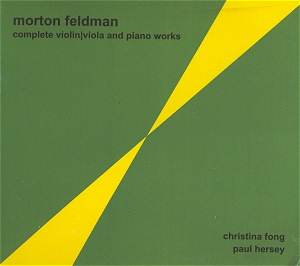
Feldman's Music for Viola and Piano--Recent recording


Morton Feldman’s star continues to rise in the years following his death in 1987. His music confuses some listeners, bores others, and challenges musicians with the prospect of performing mammoth works - in some instances running for five hours - that require utmost control and attention. This release from the minute label OgreOgress - so small they don’t give numbers to their releases - is a very important one for those who enjoy Feldman’s music. We now have several works that have not been recorded before.

One of these premier recordings is the opening [Sonata], composed in 1945 when Feldman was 19. It is a student piece and the most outwardly conventional of the works presented here, with three movements in fast/slow/fast sequence. Some would liken the sound of this piece to Bartók; for this reviewer, it calls up some of the Soviet composers of the 1920s and 1930s such as Roslavets or Lourié. The recording quality of this piece seems slightly muffled on headphones, but has very good presence on a living room system. The aesthetic of the recording suits the quiet later works especially well, with the microphone placement somewhat more distant than one would expect, allowing the ambience to act as a diffusing gauze over the ensemble.

The very short second work on the first disc, [Piece] of 1950, is sounds more like Feldman. The two instruments, interacting as if only by chance, play through their respective tones, the score bringing out many different colorations from the violin: harmonics, pizzicati, and bowed notes of widely varying pitch, as the piano plays chords of abruptly changing volume. Projection 4 and Extensions 1, the two following works, were written soon after [Piece], and are cut from the same cloth. The music here throws out spines; Feldman hasn’t yet taken to his later style of constant ppp dynamics, but over the course of these three pieces, one can see his development toward that end. The repetition or subtle colour changes of later Feldman are not here, but his sound-world is unmistakeable. The second piece from the Vertical Thoughts series, written just over a decade later than the Projection series and Extensions, has the breathless sense of suspension that marks much of Feldman’s later work.

Of the four pieces entitled The Viola in my Life, only the third is scored for viola and piano; the others are scored for the solo instrument with either chamber ensemble or orchestra. Here, the music, as well as the recording aesthetic, has receded even further from the footlights. The random sense of pitches and the occasionally confused sound has given way to a general motif of piano chords separated by rests.

Feldman, as some may already know, developed a fascination for oriental rugs, their patterns, their deviations, and this interest proved a springboard to his ideas of repetition, with slight variation, in the context of a larger — often much larger — work. Named after a mythical carpet, Spring of Chosroes is sparse, austere, contrasting with the image of a carpet of great intricacy and richness, yet corresponding in its subtly-varying repetition of motifs. Another find is the late piece [Composition] for solo violin of 1984 and the latest work presented in this release. It begins with alternating single notes and double-stops in a sort of breathing motif that the violinist carries throughout. This is a work of cold and quiet beauty which Christina Fong plays exceedingly well.

Of greatest interest to this reviewer are the two “For…” pieces that comprise the second disc of this collection. The first, For Aaron Copland, composed in 1981 and the much longer (by twelve times) For John Cage composed a year later, are haunting, bemusing, top-notch Feldman. John Cage bears a certain comparison to the Piano and String Quartet of 1985, but is far more varied regarding the repeated patterns and variation of motifs — Piano and String Quartet is a much more homogenous piece.

Fong has recorded several discs for OgreOgress including further works by Feldman, as well as John Cage, Maria de Alvear, and Alan Hovhaness. Her control is admirable, as is her wonderful tone, which never wavers over the course of these demanding works. This appears to be the only available release that Paul Hersey has recorded and he proves a sensitive pianist with careful attention to voicing and balance. Regarding this release, reviewers online and elsewhere have taken issue with the packaging of the discs. I rather like it on an aesthetic level, but from a practical standpoint, the folded card stock with silicone stubs to park the discs on doesn’t hold the recordings very securely and is easily damaged. In addition, the tracklisting is only printed on the discs themselves; if one wants to know what is playing, one needs to eject the disc. The liner notes at times remind me of the overly manic and adulatory words in a cult pamphlet I was handed on the street in Chicago some years before. For example, in reading that “there is a clarity ... as had he set light loose in a hall of mirrors, as had he charged the inherent order of randomness to work the uncertainty principle of quantum mechanics into auditory beauty that is so close to light that I sometimes believe it IS light; the sound of light; the violin sawdust, the piano glass bead; LIGHT!” I can certainly tell that the writer is excited, but this really tells a listener little about the works being presented. These shortcomings are of small concern in the overarching scheme of things. This is a great collection of rare, early, and late Feldman performed excellently.

Saturday, February 02, 2008

Robert Hass's New Book


Robert Hass: Time and Materials: Poems 1997-2005

Ecco Press, 2007

87 pp.

$22.95

Hass has inspired a certain amount of controversy in his recent work, the vortex of it being the publication of “Bush’s War” in the American Poetry Review in March, 2006. The poem was chosen by Heather McHugh for inclusion in The Best American Poetry 2007, but not everyone is convinced that the poem constitutes Hass’s best. Time and Materials, though more heavily political than his last book, has some strong work that deserves not to be eclipsed by polemic.

From a casual glance at Time and Materials, which won the National Book Award in November, one gets the sense that this is a collection centered on a particular timeframe rather than a unifying literary concept. Hass, currently the chancellor of the Academy of American Poets, served as United States Poet Laureate from 1995 to 1997 and his weekly column in the Washington Post has recently appeared in book form, Now and Then: The Poet’s Choice Columns 1997-2000 (Shoemaker & Hoard, 2007). Some of the topics touched on in Time and Materials have been seen in earlier books of his, such as his mother’s alcoholism (“The World as Will and Representation”), which figured greatly in Sun Under Wood, as well as the difficulties of the writer to adequately present what is seen and felt (“The Problem of Describing Color” and “The Problem of Describing Trees”). Much here, actually, is an exploration on how to write and what to write about. This is done in painterly fashion in the most successful poems here, not only in terms of image and color, but also in their response to artwork. In “Art and Life” Vermeer’s Woman Pouring Milk is broken down into its individual components of cloth and pigment: “Ash and ash and chalky ash—is the stickiness of paint/ Adhering to the woven flax of the canvas, here/ Is the faithfulness of paint on paint on paint.” It is this layering that inhabits the best poems here, whether of paint or meaning or, as Hass writes in the title poem, time itself; “To make layers,/ As if they were a steadiness of days.”

It is interesting that 2001 serves as the arithmetical hyphen in the middle of the range of years found in the title. There is no indication that the poems in this collection are chronologically arranged, but as with the years that followed September 2001, the latter half of Time and Materials is preoccupied with the rise (or descent) of politics, the busting out of war, and war profiteering. This can be pretty shaky ground and has been the springboard for much well-intentioned—if inconsistently good—poetry. A casual glance at a title like “Bush’s War,” would certainly give a reader a measure of concern. Hass steers clear of bombast and banner-waving, moving instead away from the headlines to the internal, to a walk in Berlin at dusk; a realization that “it is a trick of the mind/ That the past seems just ahead of us, / As if we were being shunted there/ in the surge of a rattling funicular.” This sense of History repeating is arresting, but the political poetry here can verge on oversimplification—“Why do we do it? Certainly there’s a rage/ To injure what’s injured us. Wars/ Are always pitched to us that way.” Such acts indicate a “taste for power/ That amounts to contempt for the body.” The poem ends chillingly with Goethe: “Warte nur, bald ruhest du auch. Just wait./ You will be quiet soon enough.” The speaker in “A Poem” gets lost in comparisons of the Iraq war to Vietnam. In some instances, directness pulls through, as in “Ezra Pound’s Position” which expands the earlier poet’s indictment of world finance found in the Cantos, updating it with Halliburton and other foreign interests and the sad impacts of their involvement.

In the face of bleak prospects, in the face of war, Hass has wonderful moments of great beauty. Hass holds firm in the faith of the written word’s importance—the preoccupation with being able to get it right, either in describing the red of a flitting cardinal or the aspen “doing something” (what is it?) in the wind. It is this faith that becomes the greatest hope of those who “never accepted the cruelty in the frame/ Of things, brooded on your century, and God the Monster,/ And the smell of summer grasses in the world/ That can hardly be named or remembered/ Past the moment of our wading through them,/ And the world’s poor salvation in the word.” It is here and not in the political arguments, that we see Hass’s greatest success.

Friday, February 01, 2008

Nadine Sabra Meyer's Anatomy Theater


Nadine Sabra Meyer

The Anatomy Theater

Harper Perennial, 2006

ISBN 0-06-112217-3

$13.95

Some TV shows came to mind with regard to what this book has. For those who remember Quincy, Medical Examiner, that show had it. CSI, in all its permutations, has it in spades. So, what does Nadine Sabra Meyer’s book The Anatomy Theater have? Human drama, combined with forensic science and indelible images of the body in all its intricate mechanics. John Donne, figuring in the opening and closing poems of this collection, said that the body is a map, and the physicians are “cosmographers.” After all:

The living would give anything,

it seems,

to know what the dead know,

to lift the pall

of flesh and find more than a charnel house…

This segment, from Dissection Prayers, at first seems a riff on Adrienne Rich’s “the truth the dead know,” but Meyer goes beyond that in this, her first collection. Each of the poems is written after a series of artworks. The book opens using the striking, grisly, and often whimsical anatomical prints of the 16th and 17th centuries, moving on to Toulouse-Lautrec’s lithographs and then on to a photograph of the speaker’s own surgically-removed endometriotic ovary. The lithographs and woodcuts the first section’s poems are based on are often disturbing in their whimsicality: partially-dissected cadavers going on walks or leaning against pedestals in pastoral landscapes, skeletons teaching lessons on anatomy, or cherubs taking body parts to the boiling tub for maceration. This wondrous and darkly humorous quality is well-executed by Meyer, speaking in timeless language that holds true for the most part. Occasionally it gets a bit too florid, as in Dissection Prayers’s final lines: “…their prayers/ are the susurrations of the cicada/ sloughing its shell.” or “The ice-grip stop-clenching your heart’s rondure” in the final poem of the collection, John Donne on His Deathbed. Aside from these minor instances, Meyer bypasses ornateness and goes for the greatly human. “In two hands, you carry yourself to doctors,” she writes in The Paper House, “offering up the body on a metal table, a steel shelf, a plate./ / You lay out the thing sick and invisible,/ and they look at you like you’re beautiful.” Like the early anatomists, these doctors are—as is Meyer, too, no doubt—fascinated with the machinery of the body, its toughness and fragility.

Meyer keeps the body pinned firmly to the center of each poem, first as something passive, something to be taken apart, decomposed, then as an active entity. The individual sections of the book cohere to the point that the whole collection could be seen as one long poem, as with Glück’s The Wild Iris. Across the collection, images recur, some of which are quite effective; the hoisting of a cadaver by rope and pulley, suspended from facial bones by hooks for the observers in the gallery, becomes the subject for a Toulouse-Lautrec lithograph, suspended by her teeth and spinning up to the trapeze. Others tend to be a bit more artificially placed, such as the case in Dancing at the Moulin Rouge, which begins in 1895, only to have a “plastic ring/ spun across the bar/ between forefinger and thumb.” Such an instance of anachronism jars the reader out of the poem, but this is a minor item in light of Meyer’s achievement here, which is great; unflinching, dark, and hopeful, where “in the steam of the newly-killed something like sound, like thought” might rise. Among other 16th century plates not used by Meyer is an old engraving, a portrait of Vesalius. The great anatomist is pictured looking toward the viewer, the fingers of his left hand curled around a flayed forearm; reading it, no doubt, like Braille. Meyer presents to us a tough and wonderfully unified collection; an illustration of the beauty that rises from the body’s text.

Sunday, January 27, 2008

Pre-established forms and U


Hi all--I said to myself I wasn't going to post to this blog while I had things to do, but my two works and my lecture notes for workshop all seem to be tangled up in this topic and I figured the blog might be a good dress rehearsal--so consider this the rough draft of what I'll be consumed with this week.

Forms all have a history and all have a great deal of work they can do for us. I think it significant that many cultures used specific patterns and forms as wards against evil spirits, who got caught up in them, in the great enjoyment of recognizing their recurrence, their mathematics. The Dutch had Hex signs that they placed on barns. Eastern cultures clap repeatedly. A labyrinth held the Minotaur at bay, though it's now been said that constantly turning right will get one out of even the toughest of mazes. Music soothes the savage beast. Music convinced those in charge of the Underworld to give Orpheus' wife back, under certain conditions.

If we hear beforehand that something is a limerick, we already can hum the tune of the piece, already know it's likely bawdy, and all know the rhyme scheme, the syllabics. Pop songs all tend to have that tried and true format of Verse/ Chorus/ Verse/ Chorus/ Bridge/ Verse/ Chorus/ Fadeout. Doing something that works against that while at the same time acts against it can cause tension on its own that will add interest to a piece. Sting's Fortress around Your Heart has no bridge in its formal structure, yet its lyrics repeatedly mention one--the lack of one, the need to build one. John Berryman's Dream Songs have a sonnet-like structure and hint at a sonnet-like rhyme scheme, but often haven't got it. In doing so, we read it with the background of what sonnets do (talk of problems in love and war, with more lines to discuss the problem than discuss the solution, as well as have a major turn somewhere in the second half). Pieces of music (or literature, or cinema) often end as they begin, forming patterns within larger patterns that invite further study, catch the ear or eye. Architecture often serves this funtion as well--the repeated elements of the facade, the use of established Greek orders in older architecture (Doric at bottom, then Ionic, then Corinthian at top). Using forms such as these in various works of art adds the weight of such forms, drags the long shadow of them behind the movement of your piece. The trick is in how to do this effectively--to one side of the thin line and the piece is simply an imitation, on the other the reference makes no sense and seems to add a sham depth to a piece that doesn't deserve it.
Berryman often does well at this with his Dream Songs, Berrigan as well, less often, with his sonnet sequence. Alfred Schnittke made it the mainstay of the majority of his life of composing, with a purposeful juxtaposition of the Classical with the Modern. There is the old adage of needing to know the rules before one breaks them, and it tends to hold true. There are those who seem to know the rules innately and act against them. One of my sister's children learned the music and form of language (the cadence of it, the notes it should play, the sounds it should assume) without being able to form a word of English at all. This fascinated me; his ability to communicate using only the music of language along with gesture. Forms do their work. The great learning, however, comes from what one can bring to the form, or, alternately, in billiard terms, bankshot off it to form a new trajectory.

Saturday, January 26, 2008

School in Earnest


The semester has officially started. By that I mean the trailer-load of tasks has been dumped on my shivering person--this weekend I need to cobble together two more poems, grade 20 papers, do three weeks of laundry as I've not been home in forever, pay the bills, work on lesson plans, get stuff submitted to journals, do further research for internships over the summer, read a novel by Tuesday, read lit crit, and comment on my undergrad student poems for my Monday conferences with everyone. I also need to work on revising my own stuff and get that prepared for Literary Awards in the next couple of weeks. Considering that I need to drive back to Lafayette tomorrow afternoon, that leaves a pretty jam packed 24 hours. I'll try to keep up on the blog, but...

In other news, the department is all up in arms over an email thoughtlessly sent by a grad student and things have been on edge for over a week now. If it illustrates anything, it shows the great social responsibility of everyone not to be a dumbass. Being a dumbass only ends up making other people upset and increases the chances of others being dumbasses and prolonging the pain and bother for everyone. Not being a dumbass is harder work than in sounds and I've been one on quite a few occasions. I've learned, however, what further issues that causes and am trying to avoid such incidents as much as possible. Sending out inflammatory, racially, or religiously insensitive emails is being a dumbass. Responding in an inflammatory fashion to such emails that are willfully misinformed is also being a dumbass and does no one any favors. So, in closing, remember your social responsibility, folks...lets all make it one of those January resolutions and let's try to make it stick.

Thursday, January 24, 2008

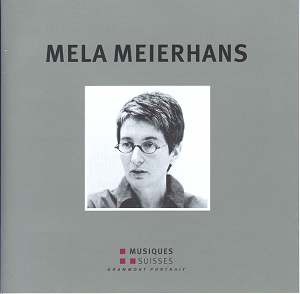
Mela Meierhans


Mela MEIERHANS (b. 1961)
Differance I for large orchestra (2000) [7:30]*

Tunnel II (2002) [22:11]**

prelude and echo (2003) [10:47]ɚ

Narziss und Echo for solo clarinet (2004) [11:14] ɸ

Essays I-V for piano and voice (2005) [14:30] ±
Basel Sinfonietta/Jürg Wyttenbach*

MUSIQUES-SUISSES MGB CTS-M 100 [66:22]


From the first steam-engine-like chugs of Differance I, listeners will know that this disc will not be filled with music that caters to the toe-tapping hummability of Pops programmes. This release, part of a series of “portrait” discs from Musiques-Suisses, spotlights the recent (the oldest piece on this disc is only seven years old) output of Mela Meierhans, who currently has five discs released. Born in 1961 in Lucerne, Meierhans has quite a few compositions to her credit. According to her website, she is currently “Artist in Residence” in Cairo, researching the next instalment of her Jenseits trilogy.

Differance I is referred to by the composer as a “consultative improvisation” for large orchestra, to be performed in the dark. Meierhans states in the excellent liner notes that the piece is intended to demonstrate a “kind of indecision; something between active and passive.” A piece filled with tension, Differance I does have this element about it, but not at all in the strange state of suspension that Morton Feldman’s music has. Here we have a greater sense of unease and even malice.

Differance I, therefore, is a perfect lead-in to Tunnel II, a work for chamber ensemble, pre-recorded tape, and soprano. The piece is based on a short story by Friedrich Dürrenmatt, in which the characters are all on a train that stalls in a tunnel that is bored through one of Switzerland’s many mountains. I won’t give away any details of the story (I’ll say the trip doesn’t end well), but Tunnel II is downright harrowing, sure to give cause for pondering well after the piece ends. The work demands a great deal of flexibility and precision from the ensemble, which Ensemble Æquatour (themselves the subject of one of Musiques-Suisses’ portrait series) and Sylvia Nopper show themselves to great effect here.

The tone lightens up somewhat with prelude and echo, a work based on five poems in English by Anne Blonstein, a Basel-based poet. Unlike Tunnel II, the vocalist speaks in undertones or in non-words. Especially striking is a sombre, ethereal section seven minutes into the piece, sounding like one of the more pensive moments from Brian Eno’s Shutov Assembly. Throughout the piece the poems themselves are minced into bits of sound. The full texts are included, perhaps to give the listener a sense of what the music used as a springboard. One particularly telling phrase of Blonstein’s is in the last section: what words will do in the future/ they wrote. a venue in risk. “Safe” music this isn’t.

Narziss und Echo is described by Meierhans as a piece in which there is yearning for Identity. In both mythical characters we have different sides of the same coin; one who is completely absorbed in the self and the other only able to find expression in the utterances of others. Of the pieces included on this disc, this could be considered the one most conventionally “accessible,” though it departs quite readily from any standard tonality. With an extremely wide array of voicings, microtonalities, and glissandi, this is quite a virtuoso piece, though not in the typical sense of the word as far as empty flash is concerned. Franco Tosi gives an electrifying performance.

Overall, this disc’s recording aesthetic, as well as its exceedingly well-thought-out liner notes, shows Musiques-Suisses has kept its interest in presenting Swiss artists in a high-quality format. This music isn’t for everybody, and even for those who have interest in avant-garde music, this might not be everyday listening. This disc, as well as other discs in this series, is certainly worth looking into for extremely compelling performances.

Sunday, January 20, 2008

Mistake Cookies


Yesterday, in the metropolis of York, Nebraska, we had dinner with my aunt Andrea, husband Drew and their ten children, and afterwards, we had something I've not tasted in well over a decade. We call them mistake cookies, a sort of refrigerator cookie discovered in the same way that Sir Alexander Fleming discovered penicillin. My grandmother was what many might euphemistically refer to as an "experimental" cook. The results of which look a bit disturbingly like a frozen beef patty, but are nothing less than cocoa, oatmeal, margarine-soaked (out here many still call it oleo) goodness.

I'll soon attempt to link a vid--something to approximate typical family proceedings in their own environment. I've no idea how to edit, so here, for good or ill, will be the raw footage for your potential enjoyment. I talk slowly in comparison to most of my relatives, so beware.

Nebraskan Nonagenarians


I've been here in the frozen tundra of Central Nebraska (subzero temps the past two nights) to celebrate my grandfather's 90th birthday. Seward is a sleepier city in wintertime, with few pedestrians (understandable considering the temperatures), the college students here busy with classes and across town. Not much has changed--the Hinky Dinky grocery store is now the much more blandly-named Sun Mart, the courthouse still presides over the central square, the bandshell rests under snow.

The day before yesterday, Uncle John said he had an extra ticket to some concert or other in Lincoln and asked if I'd be interested in going. He said it was a Russian ensemble. It turned out to be none other than the Royal Philharmonic, on tour, with the illustrious Pinchas Zuckerman conducting. Surprisingly, he played both roles of conductor and soloist for the Max Bruch Violin Concerto No. 2, not often played, and certainly not often performed conducted by the soloist. A really great performance, the only quibble I had was that the last movement of the Tchaikovsky 4th symphony was overplayed. I'll admit that, even though I knew what was coming I about lost my water when the big first chord hit. The evening was great, having spent time at dinner beforehand with the concert organist Charles Orr and his lovely wife Connie, as well as with the Owner of a local bank Steve Wake and his wife, who is one of those special people that is actually able to teach middle school kids. I've had to do that only once, and not for a long time, and I was completely exhausted. Give me college students and I'll be OK, but middle school kids act like those pictorial examples of what happens to water molecules when water comes to a boil. The Wakes and the Orrs were great conversation--we chatted about the quality of new music (as well as the quantity) composed for pipe organ (evidently both are quite good), arts education in public schools, and what tortures I might be able to put my Freshmen through upon my return to campus this week.

I'm about out of time, as we are heading for the big 90-year shindig in just a bit. More later. I've been taking notes...

Saturday, January 12, 2008

Arctic Archaeology


Found while cleaning out my icebox:

Quart of skim milk, marked "Best by Nov. 16 2007"

Squeeze bottle of mustard, marked "Best by Dec. 18, 2005"

2 Ziploc baggies containing egg-sized hailstones from a storm in April 2006

Baking-soda refrigerator deodorizer in shape of an eskimo, owned by previous house owner, who died sometime in 2000-2001

A paintbrush, in ziploc baggie, with lighter ochre paint on it, which means it was used in painting the garage. That would mean it's been in my refrigerator for three years.

--Dinner, anyone?

Monday, January 07, 2008

Day 1 Scorecard

Well, currently the lead is being held by my evil, inconsiderate, and likely methed-up upstairs neighbor, who has been getting gradually more erratic over the course of the school year. I spent last night trying to sleep while she and her various enablers did horse-laps up and down the stairs right along my apartment wall. And of course she needs to slam the door each and every time to make sure it is in fact securely fastened. All this nonsense finally stopped sometime around 4:15, leaving me an hour and 45 minutes to sleep before my 7:30 class. I awoke with a start as soon as I realized I was dreaming about Mitt Romney--not due to any political dislikes, but due to the fact that, with NPR on the clock radio, if I'm dreaming of current events, that means my alarm is going. I'd managed to sleep through almost half an hour of radio news.

The freak weather we are having (65 is the projected high, but I believe it will be warmer, as it was 63 before sunrise) has Heavilon Hall feeling like a bad basement with a heating problem. The lack of sleep and interior atmospheric conditions have me feeling like I've been brushed with oil and salt. At least the syllabi are in the can, the packet is ready for purchase at Copymat, and the books have all been ordered. Things seem to be going well so far. I just need to get through today without succumbing to a nap. And if that chick starts slamming doors again, I just may have to ask her to choose a different time to do her horse-laps. Nicely, of course.

Friday, January 04, 2008

...and furthermore....

In my meanderings, I've found that someone has already remixed the video I included in a previous post...it makes a rather interesting snippet of visual art, perhaps, though it does end prematurely.


Thursday, January 03, 2008

The Final Nail


Well, it finally happened. Mention has been made on the blogwaves about Vista's issues, including, evidently, that it ain't all that stable. Therein is the start of my story. On top of all the crap I'm having to go through because of Vista (the typing up of my student packet being the biggest pain in my ass), I get to the point where I've typed all I'm gonna type for the Poetry section of class--upwards of 50 pages of stuff--and saving it as I go. It was a poem by Heather McHugh, and the poem ended with "poetry is what/ he thought but did not say." I click "Save." The computer comes back at me with a window saying "Cannot Access File." Earth to Computer, Earth to Computer, you've not only accessed the file before, you're in it now. I've been typing on it for the past three days straight. My only option is to click the OK button. Vista is big on notification windows that pretty much just "check in" to see if you're awake to click the OK button. I click the OK button. Another notification window briefly flashes on my screen before vanishing. I could only catch a bit of a file name that had "recover" in it. Not good, I think, not good. As soon as the window vanishes, I see my 50+ page document vanish from the screen. Crap. I go back to my drive to open it up again. Windows has deleted it from my drive. As in: Gone. As in: not found on any drive. I feel all the blood drain out of my head.

After much loud oratory, I look for ways to retrieve the file. After all, Vista, with all its invasiveness, backs everything up, for your (and your nation's) security. I access that part of the program after much searching. Vista tells me that the backup portion of its services is not activated, though I distinctly remember selecting it when I was installing this turd-o-nugget program on my new laptop. No help there. And of course Vista hides all of your settings and program menus. After repeatedly getting windows notifying me that I had no authorization to open up various program files (no authorization?? It's my computer! {cue more loud oratory}), I finally find the backup file, completely by accident. I now have three separate versions of this file, in varying spots, in case this crock of crap gives me more problems. I think the least Microsoft can do to rectify this is that those of us that got suckered into buying this operating system should get free access to the Service Pack updates that Microsoft sure as heck oughta be working on 24/7. I'm not a hater. Really not a hater, but there is a special place I'd love to shove this Operating System. Let's just say it'd be in Bill Gates' direction, and it won't be pleasant. GO APPLE!

Wednesday, January 02, 2008

Windows Vista Still Sucks

I never want to deal with Microsoft ever again. I put off buying a laptop as long as I could, then when I broke down, had no choice but to buy a Vista laptop (unless I wanted to go for Apple). Vista runs slowly, my computer takes eons to shut down, Vista hides controls that I should have easy access to, and Vista won't talk to various other things, most importantly my scanner, which this semester is a vital thing for me to use. In looking at the website of those that built my scanner, they've deemed it old enough to not even bother with drivers that will allow it to talk to my Vista-ridden computer. It talked just fine with my XP computer. So...a scanner I bought three years ago and have hardly used until now is unusable. I'm so happy that Microsoft is making all of these decisions for me--which operating system I can use on my computer, which mouse I can use, when it's time to buy a scanner, even though I have a pristine one on my desk...I'm having to type out my poetry copy packet by hand, because I'm not going to have to cart an entire trunkload of books someplace so I can get poetry scanned. This has Dave more than a bit pissed. Others are saying this all more succinctly and amusingly than I am (I am far from feeling amusing at the moment), so I shall sign off with a doff of the hat to those who put together the following video:


My next computer is gonna be an Apple, by god. Microsoft, you've been put on notice.